Without missing a beat.
Nike wanted its customer-service tools to feel as well designed as its consumer products. I led creative direction and UX, initially thinking the work was about the interface. Watching the agents work changed the brief.
Creative Direction & UX
Nike · 2018
Shipped platform

I already know the answer
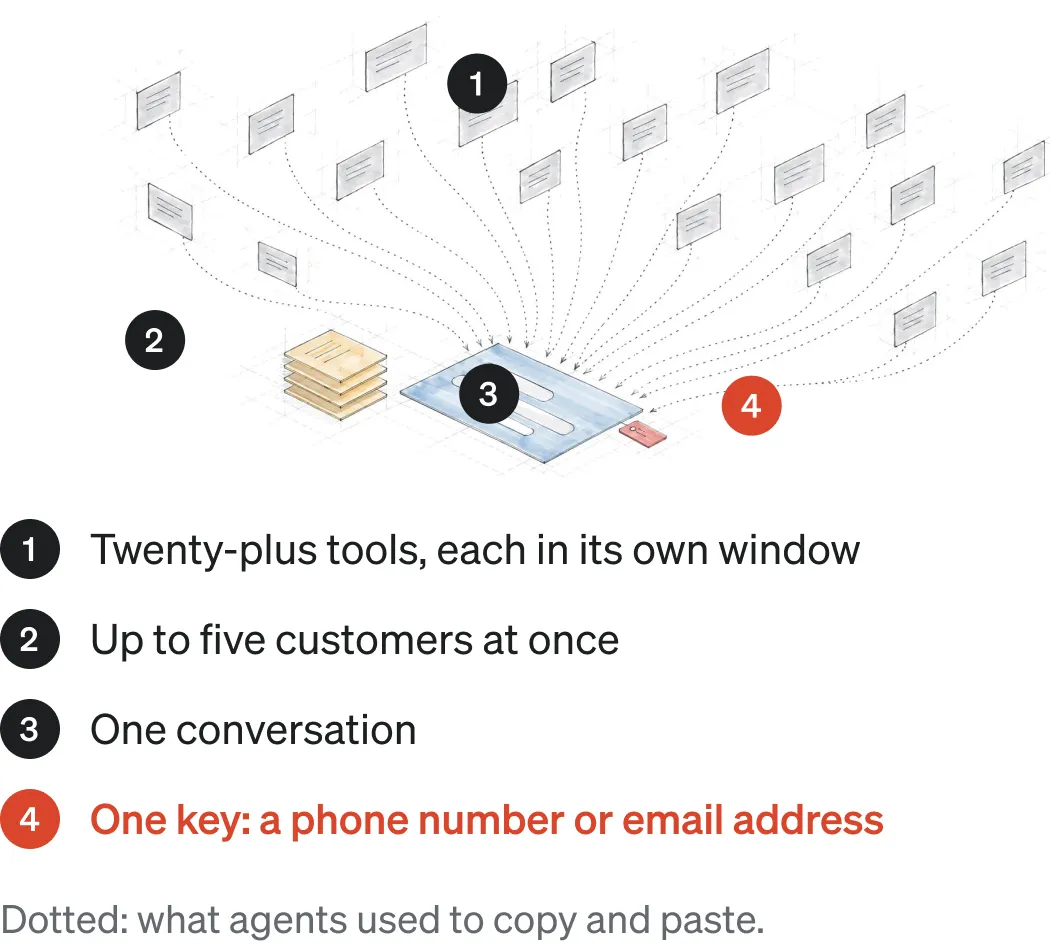
They had twenty-plus pieces of software running at once. Inventory, order trackers, a calculator. They copied from here, pasted there, waited for results and held the conversation while they worked—sometimes with five customers, depending on the channel.
They had taught themselves to work around the fragmentation. Copying and pasting had become most of the job, while their product knowledge was the part customers benefited from. We needed to give that skill somewhere else to go.

Bring them to me before I ask
We brought together the information agents had been moving between tools. Their knowledge of shoe models, release histories and things customers wouldn’t think to ask became snippets, so more people could benefit from it.
A phone number, or an email address in the email channel, could retrieve order records and the customer’s relationship with Nike. We wanted that context to appear before the agent had to ask, so they could start already knowing who they were helping.
We wanted customers to feel known without crossing into surveillance. That became a design principle.
One key, or no project
After a final UX presentation, the lead stakeholder told us they had been prepared to drop the project if we couldn’t use a single key to retrieve the full customer profile across their systems. A turnkey platform was the alternative.
IT hadn’t scoped the automation, so I had made the case with the team to product and leadership: thirty seconds saved per call, repeated across every service interaction, against a one-time development investment.
That conversation showed us how much the capability mattered to their decision. Proving the retrieval could work was the condition they named for continuing with our platform. It became standard across Nike’s customer service centers and warehouses.
